PMR to DMR: Antenna Considerations for Modern Public Safety Networks

Private Mobile Radio (PMR) has been the workhorse of professional and industrial communications for decades. From security personnel to construction sites, transport depots to manufacturing facilities — PMR provides the reliable, instant push-to-talk communications that operational teams depend upon. The migration from analogue PMR to digital DMR (Digital Mobile Radio) is now well advanced across UK industry, and for antenna users and specifiers it raises practical questions worth understanding.
PMR and DMR: The Frequency Landscape
UK PMR and DMR systems operate primarily in three frequency bands. VHF (136–174 MHz) is used for rural and semi-rural applications where long range and good building penetration is required. UHF (400–470 MHz) is the most widely used band for commercial and industrial PMR/DMR in the UK, providing better urban building penetration and supporting smaller antenna form factors. From an antenna perspective, the transition from analogue to digital (DMR) within the same band requires no change to the antenna hardware. DMR and analogue FM use the same frequency allocations; the modulation change happens within the radio, not the antenna.
Where Antenna Considerations Do Change
Simulcast and time-critical coverage. DMR Tier III trunked systems use simulcast transmission, where multiple base stations transmit the same signal simultaneously on the same frequency. Antenna systems feeding simulcast base stations must be carefully matched to ensure the signal timing and phase relationships that make simulcast work correctly are maintained. This places higher demands on cable length matching and connector quality than traditional analogue repeater installations.
In-building coverage. Modern business and industrial operations increasingly require in-building DMR coverage. Distributed Antenna Systems (DAS) for DMR in-building coverage require a different approach: many small, strategically-placed antennas rather than a small number of high-gain external antennas.
The PoC Overlay: Cellular as a PMR Complement
A growing trend alongside the analogue-to-DMR transition is Push-to-Talk over Cellular (PoC) — using LTE/4G or 5G cellular connectivity to deliver push-to-talk functionality over a national or international coverage footprint. For PoC-equipped devices and vehicle installations, this adds a cellular antenna requirement alongside or instead of the dedicated UHF or VHF PMR antenna.
What to Check When Specifying DMR Antennas
Frequency band match. Confirm the specific UHF or VHF sub-band your DMR system operates on against the antenna's rated frequency range and gain figures.
VSWR across the band. Digital modulation is more sensitive to impedance mismatch than analogue FM. A low VSWR (1.5:1 or better) across the operating band is more important for DMR system performance than it was for legacy analogue.
Cable and connector quality. Signal path quality matters more in digital systems. Use quality coaxial cable with appropriate loss figures for the run length, and weatherproof all external connections.
Browse Renair's PMR/DMR antenna range at renair.co.uk/products.
Frequently Asked Questions
Do I need to change my PMR antenna when upgrading from analogue to DMR?
Not necessarily. If your DMR radios operate in the same frequency band as your existing analogue PMR system, the antenna hardware is generally compatible. However, it's worth reviewing antenna condition and connector quality, as digital systems are more sensitive to poor connections than analogue.
What is DMR Tier III and how does it affect antenna requirements?
DMR Tier III is a trunked radio standard used by larger organisations requiring managed channel access and seamless roaming. Tier III systems use simulcast transmission, which places higher demands on antenna system consistency — particularly cable length matching between base station transmitters feeding a simulcast antenna system.
Can the same antenna serve both a DMR radio and a PoC device in a vehicle?
No — DMR (operating on UHF or VHF frequencies) and PoC (operating on cellular LTE frequencies) require antennas designed for their respective frequency bands. In a vehicle with both types of equipment, separate antennas for each are required.
Understanding the Innovative Technologies Behind Our Antenna Solutions
At Renair, we utilise cutting-edge technology to design antennas that excel in performance and reliability. Our manufacturing process incorporates rigorous testing to ensure each product meets the highest standards. This commitment to quality guarantees that our antennas provide seamless connectivity for a variety of applications.
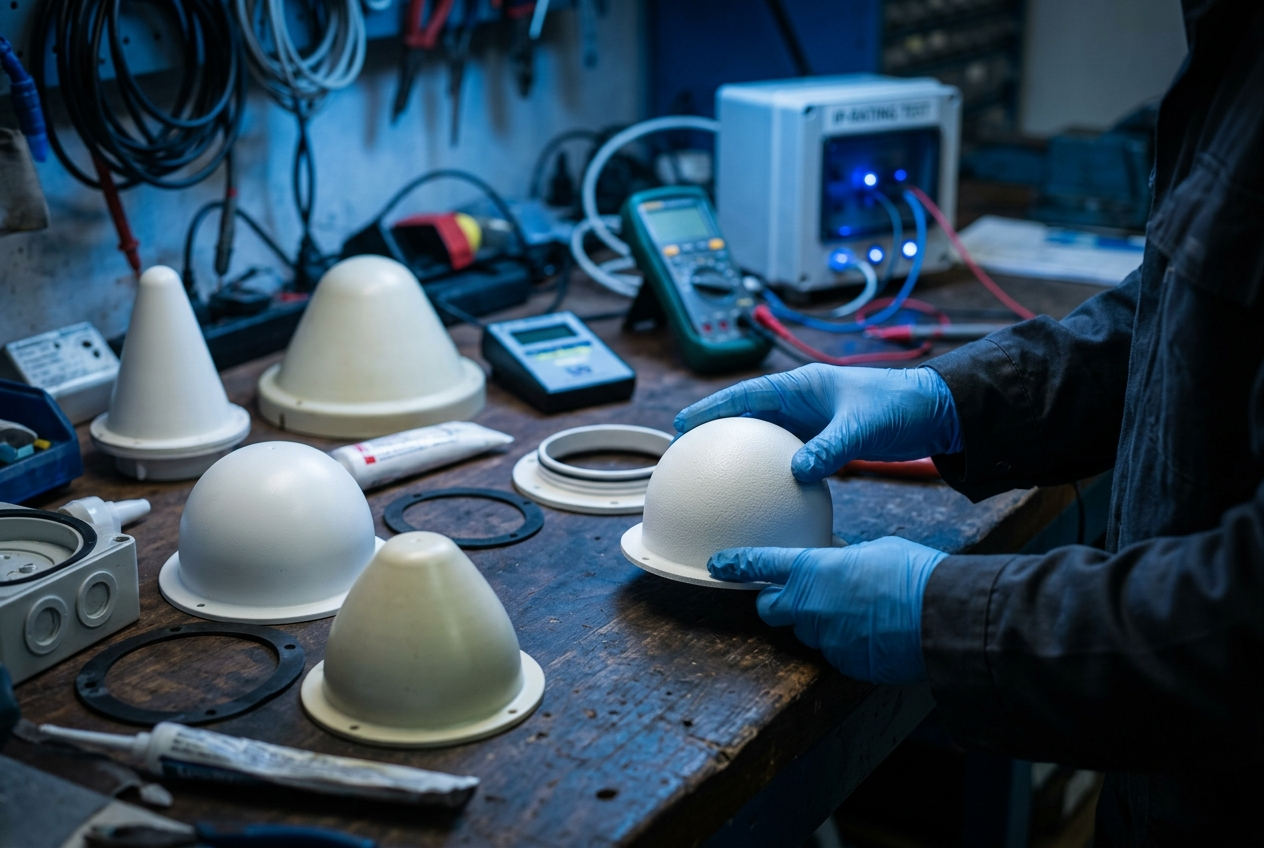
Choosing Antenna Housings and Radomes: Materials, IP Ratings and UV Resistance
A practical guide to radome materials, IP ratings, and UV resistance for specifying durable antenna housings on UK installations.

Antenna Diversity and MIMO for Fixed Wireless Access: What UK ISPs Need to Know
How antenna diversity and MIMO improve fixed wireless access performance, and what UK ISPs should specify for reliable, high-throughput deployments.

Preparing Antenna Installations for Autumn and Winter: A UK Storm-Season Checklist
A practical pre-winter checklist for UK antenna installations covering wind loading, weatherproofing, grounding, and post-storm inspection routines.
Our Customers
Lorem ipsum dolor sit amet, consectetur adipiscing elit.
“The team at Renair is always ready to assist, providing expert advice and quality products.”


“Renair’s bespoke antenna solutions have significantly enhanced our system performance.”

“We rely on Renair for all our antenna needs. Their products and service are consistently excellent.”

“Renair’s team provided exceptional support throughout our project, ensuring seamless integration.”

“The quality of Renair’s antennas is unmatched. Our communications have never been clearer.”

“Renair’s customer service is top-notch. They promptly addressed our queries and provided tailored solutions.”


Get in Touch with Us
Contact Renair today for inquiries, partnerships, or to learn more about our solutions.