UK 5G Frequency Bands and IoT Antenna Compatibility Guide
UK 5G Frequency Bands: The Landscape
5G deployment in the UK spans multiple frequency bands, each with distinct propagation characteristics and antenna requirements. Understanding these bands is essential for IoT system designers and integrators selecting the right antenna for your application.
Primary UK 5G bands:
- n78 (3400–3800 MHz): The main 5G band, deployed by all UK operators. Offers balanced propagation and indoor penetration.
- n79 (4400–5000 MHz): Secondary 5G band used primarily indoors and dense urban areas. Better indoor coverage than n78.
- FR2 (mmWave, 26–28 GHz): Ultra-high bandwidth, limited UK deployment. Line-of-sight only, suitable for fixed backhaul and indoor venues.
- Legacy 4G bands supporting IoT: 700 MHz (Band 28), 800 MHz (Band 20), 1800 MHz (Band 3), 2600 MHz (Band 7)

Why Band Selection Matters for IoT Antennas
Each frequency band presents trade-offs between coverage, interference, and antenna size. In outdoor smart city deployments, n78 provides reliable range with standard-sized omnidirectional antennas. Indoor IoT applications benefit from n79's better wall penetration, but require higher gain or MIMO arrays for deep building penetration.
The legacy 4G bands (especially 700 MHz and 800 MHz) remain essential for IoT rollouts where 5G coverage is incomplete. Many deployed IoT devices operate on LTE-M and NB-IoT on these lower bands, requiring multi-band antenna solutions.
Browse Renair's MIMO antenna range and cellular IoT antenna portfolio for solutions across these bands.
MIMO Antennas: Why 2x2 or 4x4 Improves Throughput
MIMO (Multiple-Input Multiple-Output) uses multiple antenna elements to transmit or receive different data streams simultaneously. For data-heavy IoT applications: edge computing, video surveillance, backhaul links: MIMO provides significant throughput improvement:
- 2x2 MIMO: Doubles theoretical throughput vs single antenna. Practical for mobile and portable IoT devices with space constraints.
- 4x4 MIMO: Up to 4x throughput gain. Standard for fixed installations: base stations, rooftop equipment, industrial IoT gateways.
MIMO effectiveness depends on propagation diversity. In rich scattering environments (urban areas, indoor), MIMO gains approach theoretical maximum. In line-of-sight scenarios (rooftops, rural areas), gains are lower.
Omnidirectional vs Directional for Smart City Infrastructure
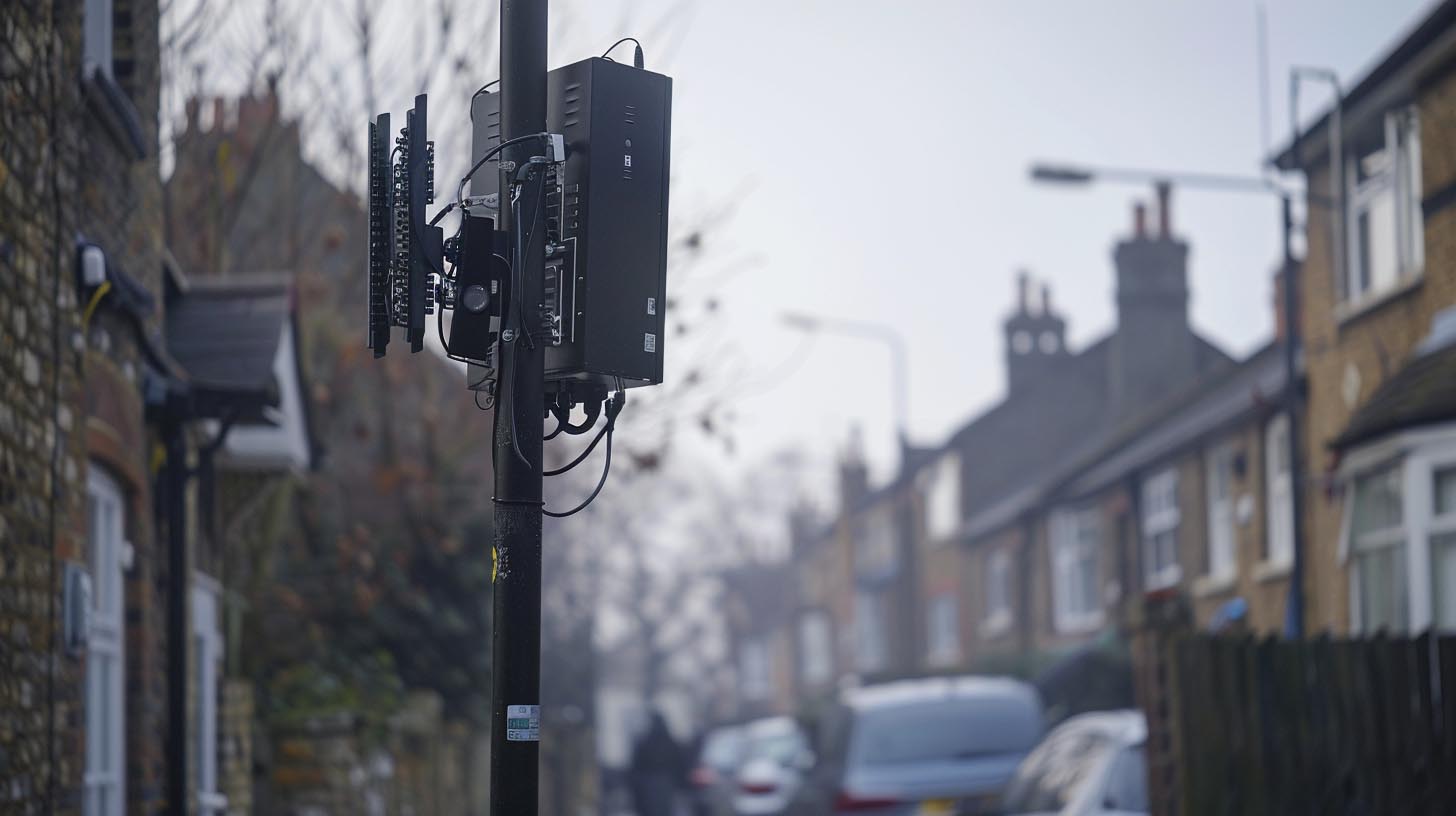
Smart city IoT deployments typically use omnidirectional antennas on street furniture, lamp columns, and traffic nodes. Omni patterns ensure coverage in all directions without requiring orientation adjustment.
Directional antennas are reserved for specific backhaul links: point-to-point gateway connections to aggregation nodes, or rooftop links between districts. The extra gain (typically 8–15 dBi) compensates for distance, but requires precise alignment.

Low-Profile Antennas on Street Furniture and Enclosures
Urban aesthetic and wind loading constraints favour low-profile antenna designs. These compact, flush-mount elements integrate into street cabinets, pole brackets, and wall enclosures without visual intrusion.
Performance trade-off: low-profile designs sacrifice some gain (typically 1–2 dBi vs 4 dBi for standard omnidirectional), but this is acceptable for dense urban IoT networks where node spacing is close.
Multi-Band IoT: Fallback to Legacy LTE
A robust IoT strategy combines n78/n79 5G with legacy 4G fallback. Many IoT gateways operate on a mix of bands for resilience. Specify combination antennas covering both 5G (n78/n79) and 4G (700/800/1800/2600 MHz) in a single element or compact array.

Deployment Checklist
- ☐ Primary coverage band selected (n78, n79, or mix)?
- ☐ Fallback 4G bands specified?
- ☐ MIMO requirement confirmed (throughput vs space trade-off)?
- ☐ Environment assessed: urban density, indoor penetration, LoS availability?
- ☐ Antenna form factor constrained (low-profile, compact)?
- ☐ Cable length and loss budget calculated?
- ☐ Environmental rating confirmed (IP, temperature, wind loading)?
Next Steps
For IoT antenna selection guidance specific to UK 5G bands, contact Renair's technical team. Browse our MIMO antenna range, multi-band combination antennas, or bespoke antenna design services for custom IoT requirements. See our full antenna product range for specification details and availability.
Related products
Related reading
Understanding the Innovative Technologies Behind Our Antenna Solutions
At Renair, we utilise cutting-edge technology to design antennas that excel in performance and reliability. Our manufacturing process incorporates rigorous testing to ensure each product meets the highest standards. This commitment to quality guarantees that our antennas provide seamless connectivity for a variety of applications.

Yagi Antennas Explained: How They Work, How Many Elements You Need and How to Size One
How a Yagi-Uda antenna works, what element count does to gain and beamwidth, a quick sizing guide for VHF and UHF, and how to choose the right Yagi for a UK installation.
5G RedCap Antennas: What IoT Designers Need
What 5G RedCap changes for IoT device design, why fewer receive antennas make each one count, and how to choose embedded and external options.

Lightning Protection for Antenna Masts
How to earth antenna masts, bond feeders and fit surge arrestors so a lightning strike does not take out radio equipment or the building it sits on.
Our Customers
Lorem ipsum dolor sit amet, consectetur adipiscing elit.
“The team at Renair is always ready to assist, providing expert advice and quality products.”


“Renair’s bespoke antenna solutions have significantly enhanced our system performance.”

“We rely on Renair for all our antenna needs. Their products and service are consistently excellent.”

“Renair’s team provided exceptional support throughout our project, ensuring seamless integration.”

“The quality of Renair’s antennas is unmatched. Our communications have never been clearer.”

“Renair’s customer service is top-notch. They promptly addressed our queries and provided tailored solutions.”


Get in Touch with Us
Contact Renair today for inquiries, partnerships, or to learn more about our solutions.