VSWR in Plain English: What Every Installer Should Check Before Going Live
.png)
Why VSWR matters more than gain
Installers spend a lot of time looking at gain figures on datasheets. In practice, the number that most reliably predicts whether an antenna system will behave itself in the field is Voltage Standing Wave Ratio (VSWR). If the VSWR is wrong, no amount of gain will save the install.
VSWR is a measure of how efficiently RF power moves from your transmitter, down the feeder, into the antenna, and out into free space. When the impedance of every stage is matched (almost always 50 ohms in our world), power transfers cleanly and VSWR is close to 1:1. When something is mismatched, power reflects back down the cable and VSWR climbs.
What good looks like
As a rough industry rule of thumb, installers work to the following VSWR targets across the working band:
Five checks worth running before you sign off
A note on return loss
VSWR and return loss are two ways of expressing the same thing. A 1.5:1 VSWR is roughly equivalent to 14 dB return loss. If your test kit reports one and your datasheet the other, a quick conversion table on your phone saves time on site.
When to call the manufacturer
If you have checked the connectors, the cable and the mount, and you are still seeing a VSWR issue that tracks with the antenna itself, it is time to talk to the manufacturer. We would rather hear from you on day one than find out in a year's time that the unit has been working hard in a corner it should never have been asked to sit in.
Need a quick sanity-check on a specific model? Email our engineering team or request a datasheet from any product page.
Understanding the Innovative Technologies Behind Our Antenna Solutions
At Renair, we utilise cutting-edge technology to design antennas that excel in performance and reliability. Our manufacturing process incorporates rigorous testing to ensure each product meets the highest standards. This commitment to quality guarantees that our antennas provide seamless connectivity for a variety of applications.
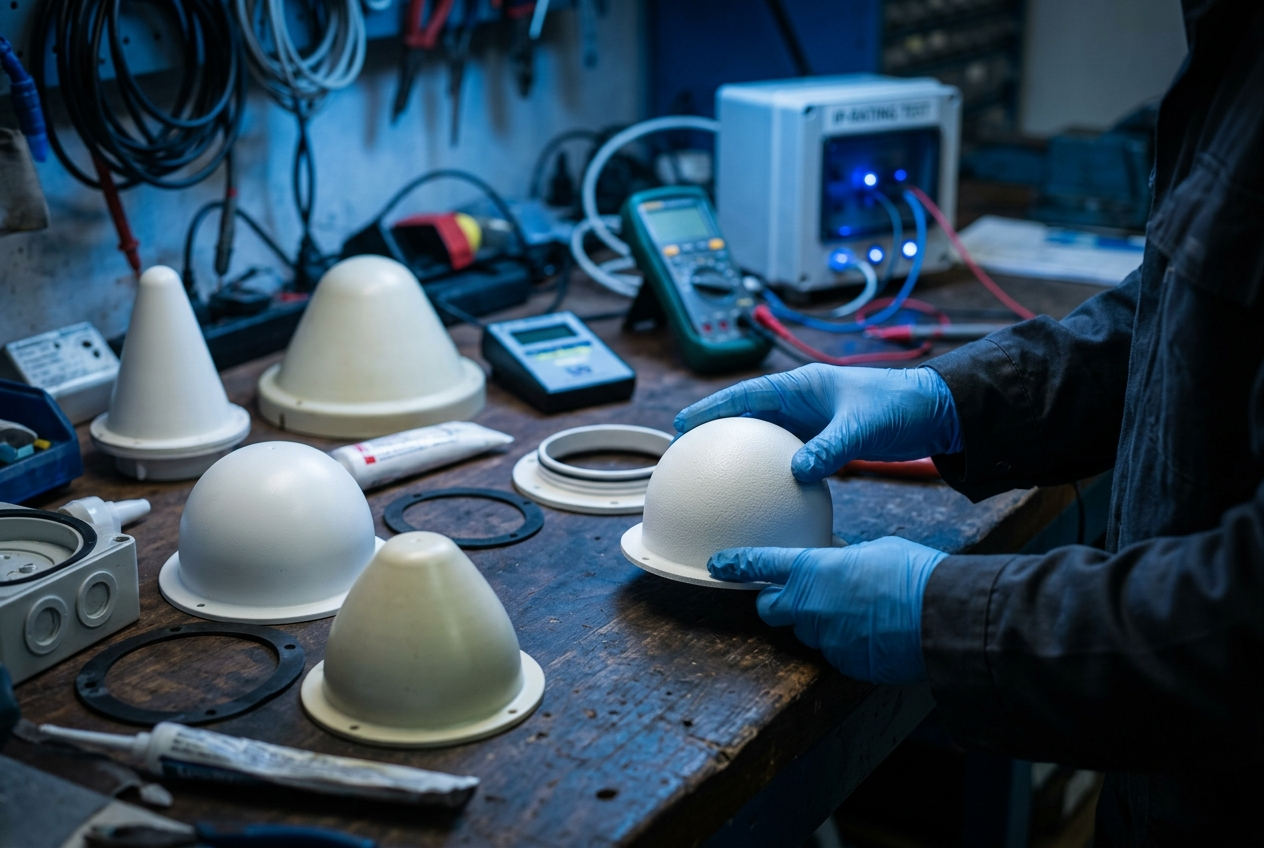
Choosing Antenna Housings and Radomes: Materials, IP Ratings and UV Resistance
A practical guide to radome materials, IP ratings, and UV resistance for specifying durable antenna housings on UK installations.

Antenna Diversity and MIMO for Fixed Wireless Access: What UK ISPs Need to Know
How antenna diversity and MIMO improve fixed wireless access performance, and what UK ISPs should specify for reliable, high-throughput deployments.

Preparing Antenna Installations for Autumn and Winter: A UK Storm-Season Checklist
A practical pre-winter checklist for UK antenna installations covering wind loading, weatherproofing, grounding, and post-storm inspection routines.
Our Customers
Lorem ipsum dolor sit amet, consectetur adipiscing elit.
“The team at Renair is always ready to assist, providing expert advice and quality products.”


“Renair’s bespoke antenna solutions have significantly enhanced our system performance.”

“We rely on Renair for all our antenna needs. Their products and service are consistently excellent.”

“Renair’s team provided exceptional support throughout our project, ensuring seamless integration.”

“The quality of Renair’s antennas is unmatched. Our communications have never been clearer.”

“Renair’s customer service is top-notch. They promptly addressed our queries and provided tailored solutions.”


Get in Touch with Us
Contact Renair today for inquiries, partnerships, or to learn more about our solutions.