5G RedCap Antennas: What IoT Designers Need
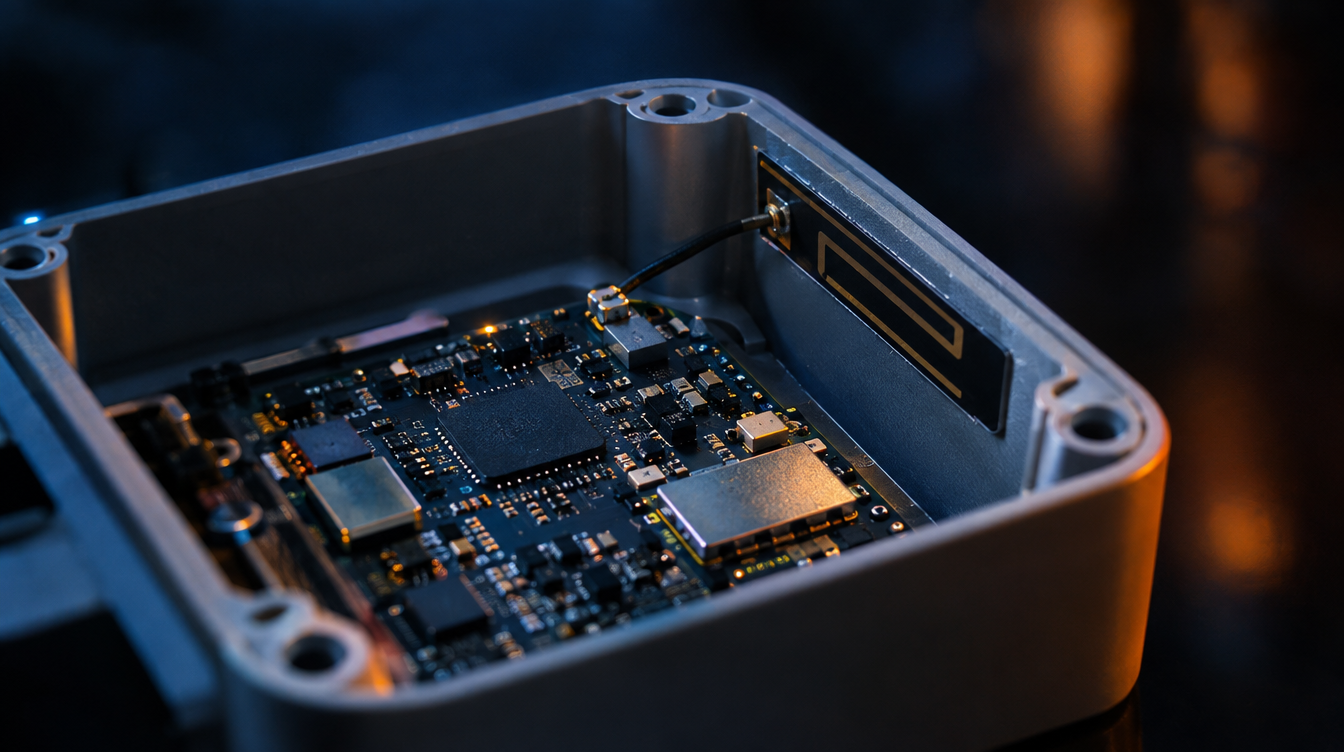
5G RedCap, short for Reduced Capability, was introduced in 3GPP Release 17 to fill the gap between low-power LTE-M and NB-IoT and full 5G. It targets wearables, industrial sensors, video surveillance and other devices that need more throughput than LPWA but not the cost and power draw of a full 5G modem.
What RedCap changes
- Narrower bandwidth. Maximum bandwidth in the sub-6 GHz range is reduced to 20 MHz.
- Fewer receive paths. Devices can use one or two receive antennas instead of the two or four used by standard 5G devices.
- Simpler hardware. Lower cost, smaller modules and better battery life.
Release 18 adds enhanced RedCap with further reductions for lower-end devices.
Why antenna design matters more
A full 5G device with four receive antennas can make up for one poorly placed antenna through diversity. A single-antenna RedCap device has no such backup. Every decibel of antenna efficiency lost to a cramped PCB, a nearby battery or a metal housing comes straight off the link budget, which shows up as dropped connections and higher power use at the cell edge.
Embedded options
For devices with space inside a plastic enclosure, flexible antennas give good efficiency and are easy to position. The 2JF0683P and 2JF0483P cover 617 to 5925 MHz in a flexible polymer format. Where space is tight, a surface-mount design such as the 2JE71 Brick can be placed directly on the PCB. Keep the antenna as far as possible from the battery, display and any metal shielding.
External options
Devices in metal enclosures, such as street furniture and industrial cabinets, need an external antenna. Ground plane independent adhesive types such as the 2J5283P T-Bar can be fixed inside a plastic window, while vandal-resistant screw mounts such as the 2J7183Ba suit exposed outdoor locations.
Plan for certification
Operators and certification bodies test radiated performance of the complete device. An antenna that performs well in free space can fail once it is inside the enclosure. Prototype with the final housing early, measure total radiated power and sensitivity, and leave room in the schedule for antenna tuning.
Frequently asked questions
Is RedCap the same as LTE-M?
No. LTE-M is a low-power LTE technology. RedCap is a reduced capability version of 5G NR, offering higher throughput than LTE-M with lower cost and power than full 5G devices.
How many antennas does a RedCap device need?
In the sub-6 GHz range, a RedCap device can use one or two receive antennas. Two gives better performance at the cell edge.
Can I use an existing 4G antenna for RedCap?
Only if it covers the 5G bands the device will use. Wideband antennas covering 617 to 5925 MHz support both LTE and 5G.
For LTE-based alternatives, read our 4G LTE antenna guide for IoT. To discuss antennas for a RedCap design, contact sales@renair.co.uk.
Understanding the Innovative Technologies Behind Our Antenna Solutions
At Renair, we utilise cutting-edge technology to design antennas that excel in performance and reliability. Our manufacturing process incorporates rigorous testing to ensure each product meets the highest standards. This commitment to quality guarantees that our antennas provide seamless connectivity for a variety of applications.

Marine VHF Channels in the UK: Full Channel List and What Each One Is For
The UK marine VHF channels you need to know, from Channel 16 and DSC Channel 70 to intership, port operations and marina channels, with frequencies and tips for reliable coverage.

LoRa Antennas for 868 MHz: How to Choose, Connect and Mount Them
A practical guide to LoRa antennas for UK and EU 868 MHz networks: antenna types for gateways and end devices, SMA vs RP-SMA connectors, ground planes and how to get the most range.

PMR446 Frequencies in the UK: Channels, Rules and When You Need a Licensed Radio
All 16 UK PMR446 channels and frequencies, the licence-free rules that apply, and the point at which a business is better served by licensed UHF radio and a proper antenna.
Our Customers
Lorem ipsum dolor sit amet, consectetur adipiscing elit.
“The team at Renair is always ready to assist, providing expert advice and quality products.”


“Renair’s bespoke antenna solutions have significantly enhanced our system performance.”

“We rely on Renair for all our antenna needs. Their products and service are consistently excellent.”

“Renair’s team provided exceptional support throughout our project, ensuring seamless integration.”

“The quality of Renair’s antennas is unmatched. Our communications have never been clearer.”

“Renair’s customer service is top-notch. They promptly addressed our queries and provided tailored solutions.”


Get in Touch with Us
Contact Renair today for inquiries, partnerships, or to learn more about our solutions.