Antenna Radomes: Materials, IP Ratings and UV
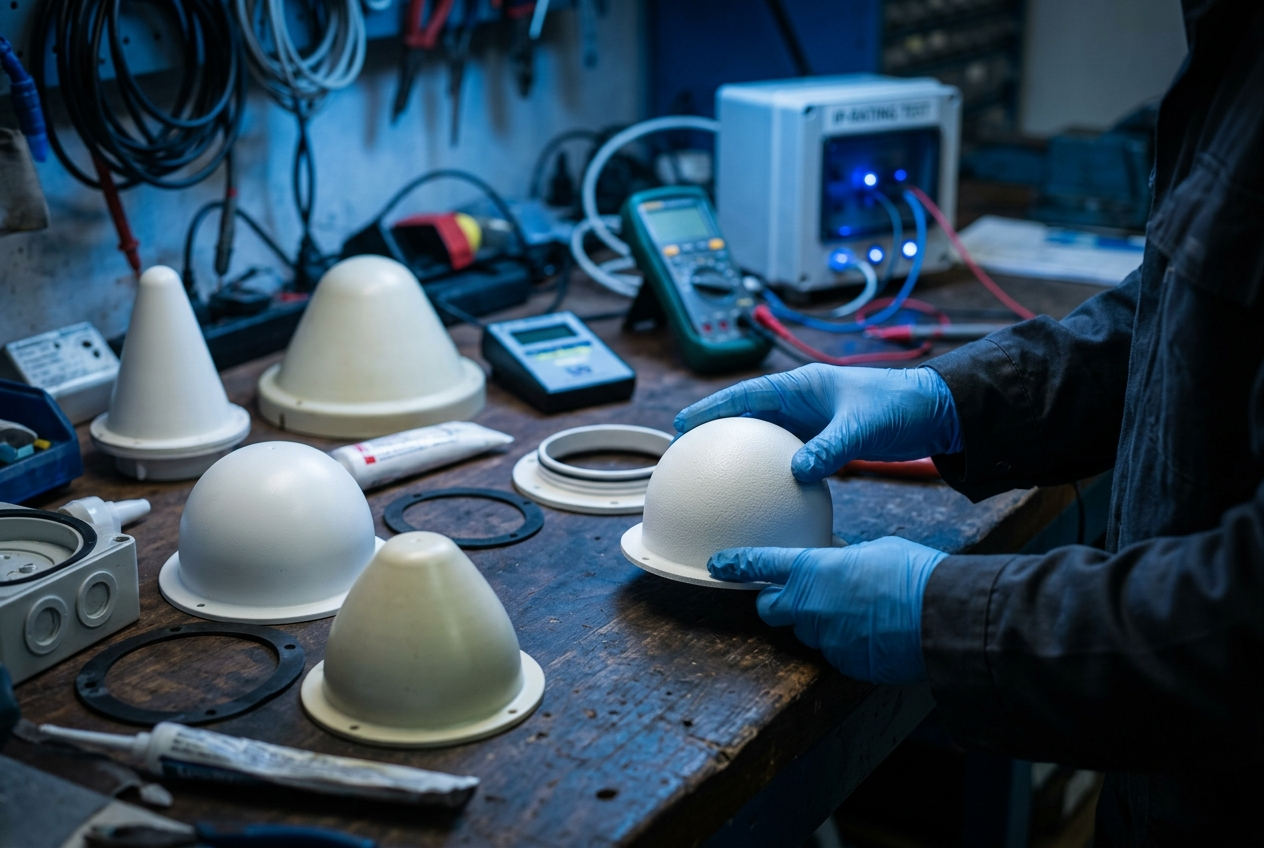
What does a radome do?
A radome is the protective housing surrounding an antenna's radiating elements, shielding them from wind, rain, ice, UV exposure, and physical impact while remaining as close to radio-transparent as possible. A well-specified radome adds years to an antenna's service life with negligible impact on RF performance; a poorly specified one can introduce signal loss, water ingress, and premature mechanical failure well before the electronics inside would otherwise need replacing.
Radome materials compared
Fibreglass (GRP)
Glass-reinforced plastic is the most common radome material for outdoor panel and sector antennas. It offers a strong balance of mechanical strength, RF transparency, and UV resistance when properly formulated with UV-stabilising additives, and it tolerates the UK's wide temperature and moisture range well. GRP radomes are typically the preferred choice for permanent rooftop and tower installations where long service life is expected.
ABS and polycarbonate
ABS and polycarbonate housings are common on smaller antennas, indoor units, and cost-sensitive applications. They are lighter and less expensive to produce than GRP but are generally more susceptible to UV degradation over time unless specifically UV-stabilised, and can become brittle in prolonged cold exposure. These materials suit shorter-life or indoor-adjacent applications better than long-term exposed outdoor deployments.
PTFE and specialist RF-transparent materials
For high-frequency and precision applications, such as certain 5G mmWave or specialist radar antennas, PTFE-based and other low-loss dielectric materials are used where even the small insertion loss of standard GRP or plastic becomes significant. These materials carry a higher cost premium and are typically reserved for applications where their RF performance justifies it.
IP ratings explained
IP65 vs IP66 vs IP67
IP (Ingress Protection) ratings describe resistance to solid particles and water, expressed as two digits: the first for dust/particle ingress, the second for water. For outdoor antenna housings, the relevant distinctions are usually in the second digit:
- IP65: Protected against low-pressure water jets from any direction. Adequate for most sheltered or moderately exposed outdoor installations.
- IP66: Protected against powerful water jets from any direction. The common baseline specification for exposed rooftop, tower, and coastal antenna housings in the UK.
- IP67: Protected against temporary immersion up to 1 metre. Typically specified where an enclosure could realistically become submerged, such as low-mounted equipment in flood-prone locations.
For the great majority of UK outdoor antenna deployments, IP66 represents the appropriate baseline; specifying IP67 where it is not functionally needed adds cost without a corresponding benefit, while specifying only IP65 on a heavily exposed coastal or elevated site leaves a real risk of water ingress under driving rain and wind-loaded conditions.
UV resistance and weathering
UK outdoor installations experience meaningful UV exposure even in a temperate climate, and unstabilised plastics degrade measurably within a few years, becoming brittle, discoloured, and eventually prone to cracking. Specify radome materials with UV-stabilising additives (commonly listed as UV-stabilised GRP or UV-stabilised ABS on datasheets) for any installation expected to remain in service for more than two to three years, which in practice means nearly all permanent antenna installations.
RF transparency and signal loss considerations
Every radome material introduces some insertion loss, though for correctly specified materials at typical antenna operating frequencies this is usually well under 0.5 dB, negligible against the overall link budget. Loss increases with material thickness, moisture absorption, and frequency, which is why higher-frequency applications require closer attention to material selection. A radome that has absorbed moisture over time, due to a hairline crack or degraded seal, will show measurably higher insertion loss than a new one of the same material and thickness, which is one reason routine visual inspection for housing damage is worth including in any antenna maintenance schedule.
Selecting the right housing for your application
- Exposure level: Coastal, elevated, or otherwise heavily exposed sites justify IP66 and UV-stabilised GRP as a default; sheltered or indoor-adjacent sites may suit lighter ABS or polycarbonate housings.
- Expected service life: Match material UV stabilisation and mechanical robustness to how long the installation is expected to remain in place without replacement.
- Operating frequency: Higher-frequency applications warrant closer scrutiny of radome insertion loss specifications; standard GRP is adequate for the large majority of sub-6 GHz applications.
- Mounting environment: Consider physical impact risk (falling ice, debris, maintenance access) alongside weather exposure when specifying housing thickness and mechanical rating.
Summary checklist
- Default to IP66-rated, UV-stabilised GRP housings for permanent UK outdoor installations.
- Reserve IP67 for genuine immersion risk rather than specifying it as standard.
- Confirm radome insertion loss figures on the datasheet for higher-frequency applications.
- Inspect radomes for cracking, discolouration, or seal degradation during routine maintenance visits.
- Match material choice to expected service life rather than defaulting to the lowest-cost option.
For guidance on radome materials and IP-rated antenna housings for UK deployments, contact Renair's technical team at sales@renair.co.uk.
Related products
Related reading
Understanding the Innovative Technologies Behind Our Antenna Solutions
At Renair, we utilise cutting-edge technology to design antennas that excel in performance and reliability. Our manufacturing process incorporates rigorous testing to ensure each product meets the highest standards. This commitment to quality guarantees that our antennas provide seamless connectivity for a variety of applications.

VHF vs UHF Antennas: Which Do You Need?
The difference between VHF and UHF antennas in plain English: range, terrain, building penetration, antenna size and which sectors use which band.

Do You Need a VHF Radio Licence in the UK? Ofcom Rules Explained
Which licences you need to use a marine VHF radio in the UK: the Ofcom Ship Radio Licence, the Ship Portable Radio Licence and the operator's certificate, plus what changes for land-based VHF.

UK Airband Frequencies: A Guide for Airfields, Flying Clubs and Listeners
How the UK aviation VHF airband works, from 118 to 137 MHz and 8.33 kHz channel spacing to the emergency frequency, plus how to choose an airband antenna for an airfield or ground station.
Our Customers
Lorem ipsum dolor sit amet, consectetur adipiscing elit.
“The team at Renair is always ready to assist, providing expert advice and quality products.”


“Renair’s bespoke antenna solutions have significantly enhanced our system performance.”

“We rely on Renair for all our antenna needs. Their products and service are consistently excellent.”

“Renair’s team provided exceptional support throughout our project, ensuring seamless integration.”

“The quality of Renair’s antennas is unmatched. Our communications have never been clearer.”

“Renair’s customer service is top-notch. They promptly addressed our queries and provided tailored solutions.”


Get in Touch with Us
Contact Renair today for inquiries, partnerships, or to learn more about our solutions.