Antenna Polarisation Explained: Vertical, Horizontal, and When It Matters
What polarisation actually is
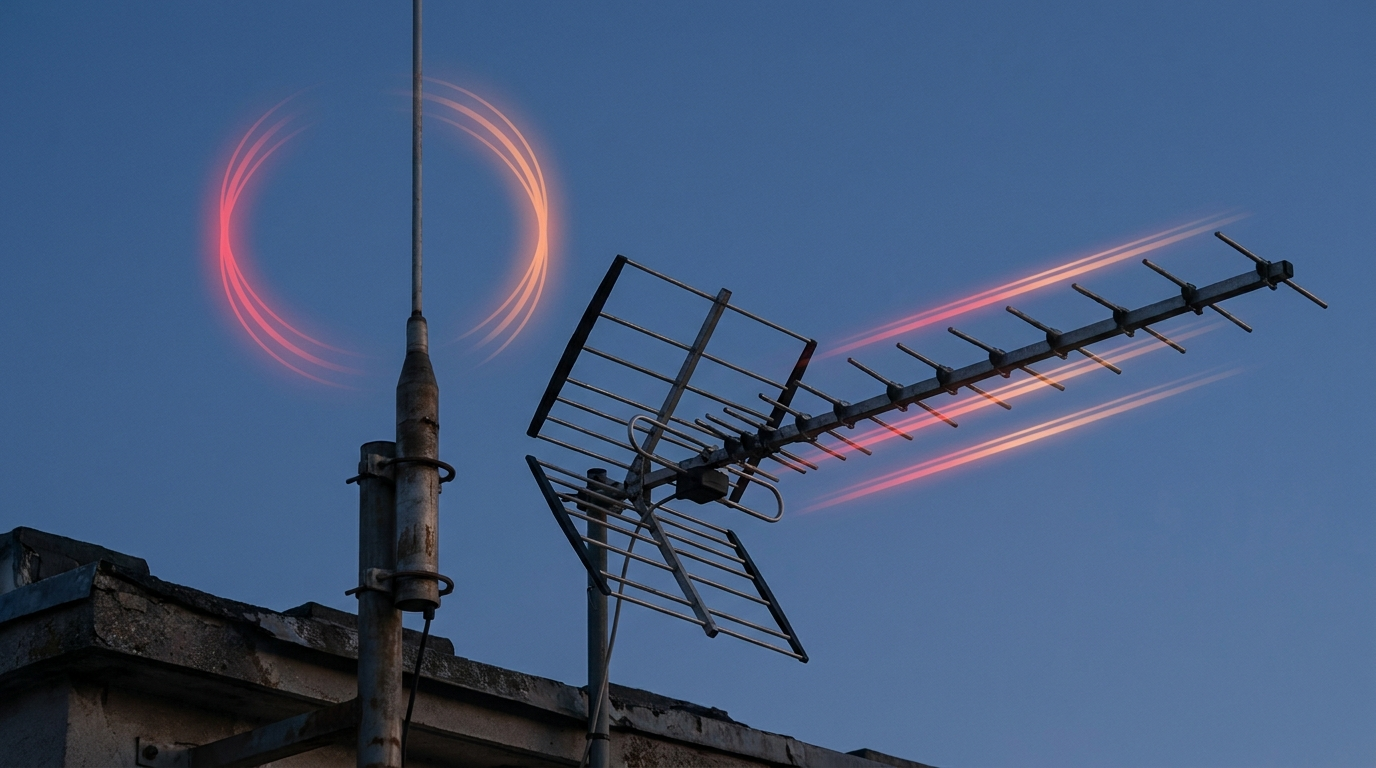
Polarisation describes the orientation of the electric field in the radio wave your antenna radiates. If the electric field oscillates up and down, the wave is vertically polarised. If it oscillates side to side, it is horizontally polarised. Circular and slant polarisations are more complex variations of the same idea.
The reason this matters is simple: when a receiving antenna is orientated to match the transmitter, the link is strong. When they are cross-polarised by ninety degrees, you can lose 20 dB or more of signal, which is often the difference between a working radio and a dead one.
When to specify vertical
Vertical polarisation is the default across most UK public safety, commercial and marine applications. The reasons are practical:
- Vertical whips and rods are mechanically simple and rugged.
- Vertical radiation patterns play well with mobile equipment, where receiver orientation varies.
- Ground plane interactions are well understood and predictable.
If you are specifying for TETRA, DMR, LTE public safety bands, marine VHF, AIS or most vehicle-mounted applications, vertical is almost certainly your answer.
When horizontal still earns its keep
Horizontal polarisation appears in three specific contexts worth knowing:
Broadcast transmission
Horizontal polarisation offers useful multipath properties at VHF and UHF for analogue and digital broadcast applications. It remains the default for legacy terrestrial broadcast infrastructure in the UK.
Long-distance HF and VHF radio
On lower amateur and fixed-link bands, horizontal antennas can have propagation advantages for long-distance sky-wave paths. Not relevant for most professional mobile radio applications, but occasionally specified for fixed-link work.
Point-to-point frequency reuse
Polarisation diversity can provide a second logical channel on the same frequency by using cross-polarised antennas at each end. Useful in licensed microwave and backhaul links where spectrum efficiency is at a premium.
Slant and circular polarisation
Slant polarisation
Slant (typically +45 and -45 degrees) is widely used in cellular base station deployment. It gives operators two cross-polarised data streams from a single radome and is a key building block for MIMO. If you are specifying base station sector antennas for cellular applications, slant-polarised dual-port antennas are the standard.
Circular polarisation
Circular polarisation, where the electric field rotates, is standard on most GPS and GNSS antennas because it tolerates rotation of the satellite and receiver without major signal loss. For GPS, specify right-hand circular polarisation (RHCP). Left-hand circular (LHCP) is the wrong polarisation for GPS and will cost you 20 or more dB at the feed point.
The practical checklist
- Match polarisation at both ends of the link. This sounds obvious, and it is, but check it on site.
- If you have a choice, go vertical for mobile and handheld applications. The human factor always wins.
- For GPS and GNSS, specify RHCP explicitly. Do not accept 'circular' without confirming the hand.
- Renair's public safety and mobile units are specified as vertical as standard, with horizontal and slant variants available on request.
Not sure what is right for a specific install? Talk to one of our engineers before you order.
Understanding the Innovative Technologies Behind Our Antenna Solutions
At Renair, we utilise cutting-edge technology to design antennas that excel in performance and reliability. Our manufacturing process incorporates rigorous testing to ensure each product meets the highest standards. This commitment to quality guarantees that our antennas provide seamless connectivity for a variety of applications.

Choosing Antenna Housings and Radomes: Materials, IP Ratings and UV Resistance
A practical guide to radome materials, IP ratings, and UV resistance for specifying durable antenna housings on UK installations.

Antenna Diversity and MIMO for Fixed Wireless Access: What UK ISPs Need to Know
How antenna diversity and MIMO improve fixed wireless access performance, and what UK ISPs should specify for reliable, high-throughput deployments.

Preparing Antenna Installations for Autumn and Winter: A UK Storm-Season Checklist
A practical pre-winter checklist for UK antenna installations covering wind loading, weatherproofing, grounding, and post-storm inspection routines.
Our Customers
Lorem ipsum dolor sit amet, consectetur adipiscing elit.
“The team at Renair is always ready to assist, providing expert advice and quality products.”


“Renair’s bespoke antenna solutions have significantly enhanced our system performance.”

“We rely on Renair for all our antenna needs. Their products and service are consistently excellent.”

“Renair’s team provided exceptional support throughout our project, ensuring seamless integration.”

“The quality of Renair’s antennas is unmatched. Our communications have never been clearer.”

“Renair’s customer service is top-notch. They promptly addressed our queries and provided tailored solutions.”


Get in Touch with Us
Contact Renair today for inquiries, partnerships, or to learn more about our solutions.