UK Smart Meter Antennas: 2026 Selection Guide
UK smart metering context
The UK's smart metering rollout is approaching a critical juncture. The SMETS2 programme, coordinated by the Data Communications Company (DCC), has deployed over 12 million smart meters, with near-universal coverage as the programme target. Choosing the right antenna for meter communication modules is essential for reliability, cost, and future-proofing.
Smart meters communicate via one of three primary protocols:
- NB-IoT (narrowband IoT on 4G infrastructure)
- LoRaWAN (low-power wide-area network)
- LTE-M (cellular IoT fallback)
Each protocol has distinct antenna requirements based on frequency band, power budget, and deployment environment.
NB-IoT vs LoRaWAN: antenna implications
NB-IoT
NB-IoT operates on 700 MHz and 800 MHz bands. These lower frequencies penetrate buildings well, making them ideal for meters installed inside homes or in basement utility rooms. NB-IoT achieves excellent link budgets (up to 164 dB), so compact antennas suffice. Power consumption is low: a standard battery can last five or more years in typical urban deployment.
LoRaWAN
LoRaWAN operates at 868 MHz (EU/UK band). It provides even longer range than NB-IoT in outdoor scenarios, but indoor penetration is slightly worse at higher frequency. LoRaWAN also requires a dedicated gateway network, separate from cellular infrastructure. This is a trade-off: LoRaWAN is cheaper per-device at scale (no cellular carrier subscription), but requires the meter operator to own or lease gateway infrastructure.
For antenna selection, NB-IoT and LoRaWAN favour similar antenna types (omnidirectional, moderate gain), but the frequency difference affects ground plane requirements and form factor.
Urban vs rural deployment trade-offs
Dense urban deployment
In London, Manchester, Birmingham and similar cities, base station density is high and 700/800 MHz coverage is near-universal. Signal levels close to base stations are typically above -80 dBm. Multipath propagation is severe: signals bounce off buildings, creating interference patterns.
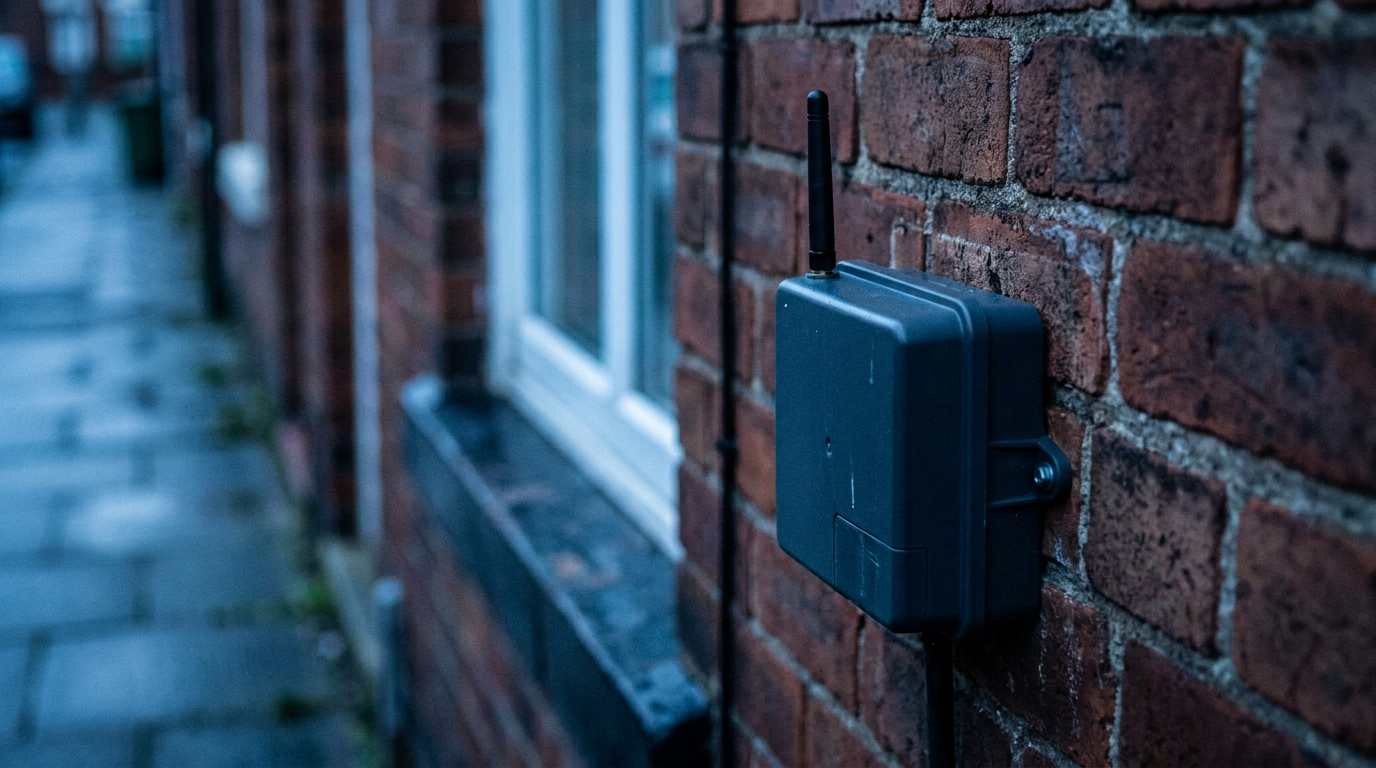
Low-profile, compact omnidirectional antennas are preferred. Standard whip antennas on meter cabinets can be visually obtrusive; low-profile patch antennas integrate more cleanly into cabinet lids or external housings.
Rural and semi-rural deployment
In rural areas, farmland, villages and remote Scotland, base station coverage may be sparse or distant. Link budgets are tight, with signal levels at -100 dBm or lower common at the meter location. Multipath is minimal in open country, so directional antennas can provide gain without significant multipath penalty.
Standard omnidirectional antennas with slightly higher gain (3 to 5 dBi) are acceptable for most semi-rural locations. Where coverage is genuinely marginal, directional antennas (7 to 8 dBi) may be required, but they need to be oriented towards the base station or gateway during installation.
Why omnidirectional antennas can underperform in dense urban areas
Standard omnidirectional whip antennas radiate equally in all directions. In dense urban areas with multiple nearby base stations, this means the antenna picks up signal from both the nearest strong base station and from weaker ones further away, increasing multipath distortion and interference.
A low-profile antenna with a flat or slightly directional pattern, using a ground plane underneath, can suppress signals arriving from certain angles and reduce multipath fading. Visual and mechanical constraints in urban environments also make compact antennas more practical than large external whips.
External meter cabinet mounting: IP rating and environmental
Most smart meters have their communication module mounted externally on the meter cabinet to improve RF coverage. External mounting requires:
- IP67 minimum rating for dust and water protection. Many combination antennas for smart metering specify IP67 or IP68 compliance.
- Temperature range: UK meter cabinets experience -10 C to +60 C operating range. Confirm the antenna's temperature specification covers this span.
- UV resistance: External antennas exposed to sunlight degrade without UV stabilisation in the radome material.
- Wind loading: Confirm the antenna is rated for wind loading where exposed locations are likely.
MIMO considerations for 4G fallback
Some deployments use LTE-M as a fallback if NB-IoT coverage fails. 4G can deliver higher data rates, useful for fast meter readouts or firmware updates. 4G on 700 MHz or 800 MHz can use 2x2 MIMO antennas to improve throughput, but this adds complexity and cost. In practice, most smart meters do not require MIMO as data throughput is low. Specify MIMO only if your application demands higher data rates or lower latency.
Antenna selection summary
A simplified decision guide. Exact choice depends on your specific deployment area and link budget calculations.
| Deployment type | Primary protocol | Recommended antenna |
|---|---|---|
| Urban residential | NB-IoT 700/800 MHz | Low-profile omnidirectional |
| Urban dense (inner city) | NB-IoT 700/800 MHz | Compact patch antenna (flush-mount cabinet) |
| Semi-rural | NB-IoT 700/800 MHz | Standard omnidirectional, 3 to 5 dBi |
| Rural/remote | LoRaWAN 868 MHz or LTE-M | Higher-gain omnidirectional or directional |
| Multi-protocol fallback | NB-IoT primary, 4G secondary | Dual-band combination antenna |
Specification checklist
- Protocol confirmed: NB-IoT, LoRaWAN, 4G, or combination?
- Frequency bands specified: 700 MHz, 800 MHz, 868 MHz, or 1800 MHz?
- Deployment area classified: urban, semi-rural, or rural?
- Link budget calculated: base station distance, antenna gain, cable loss?
- Form factor requirement clear: low-profile, compact, or standard whip?
- Environmental rating confirmed: IP67 minimum, temperature, UV, wind?
- Cable type and length specified: low-loss coax for longer runs?
- Type approval confirmed: SMETS2 compliance where required?
Next steps
For antenna selection and supply tailored to your UK smart metering rollout, contact Renair's technical team at sales@renair.co.uk. We supply NB-IoT, LoRaWAN, and cellular IoT antennas for smart meter applications across the UK.
Related products
Related reading
Understanding the Innovative Technologies Behind Our Antenna Solutions
At Renair, we utilise cutting-edge technology to design antennas that excel in performance and reliability. Our manufacturing process incorporates rigorous testing to ensure each product meets the highest standards. This commitment to quality guarantees that our antennas provide seamless connectivity for a variety of applications.

VHF vs UHF Antennas: Which Do You Need?
The difference between VHF and UHF antennas in plain English: range, terrain, building penetration, antenna size and which sectors use which band.

Do You Need a VHF Radio Licence in the UK? Ofcom Rules Explained
Which licences you need to use a marine VHF radio in the UK: the Ofcom Ship Radio Licence, the Ship Portable Radio Licence and the operator's certificate, plus what changes for land-based VHF.

UK Airband Frequencies: A Guide for Airfields, Flying Clubs and Listeners
How the UK aviation VHF airband works, from 118 to 137 MHz and 8.33 kHz channel spacing to the emergency frequency, plus how to choose an airband antenna for an airfield or ground station.
Our Customers
Lorem ipsum dolor sit amet, consectetur adipiscing elit.
“The team at Renair is always ready to assist, providing expert advice and quality products.”


“Renair’s bespoke antenna solutions have significantly enhanced our system performance.”

“We rely on Renair for all our antenna needs. Their products and service are consistently excellent.”

“Renair’s team provided exceptional support throughout our project, ensuring seamless integration.”

“The quality of Renair’s antennas is unmatched. Our communications have never been clearer.”

“Renair’s customer service is top-notch. They promptly addressed our queries and provided tailored solutions.”


Get in Touch with Us
Contact Renair today for inquiries, partnerships, or to learn more about our solutions.