TETRA Base Station Antenna Maintenance Guide
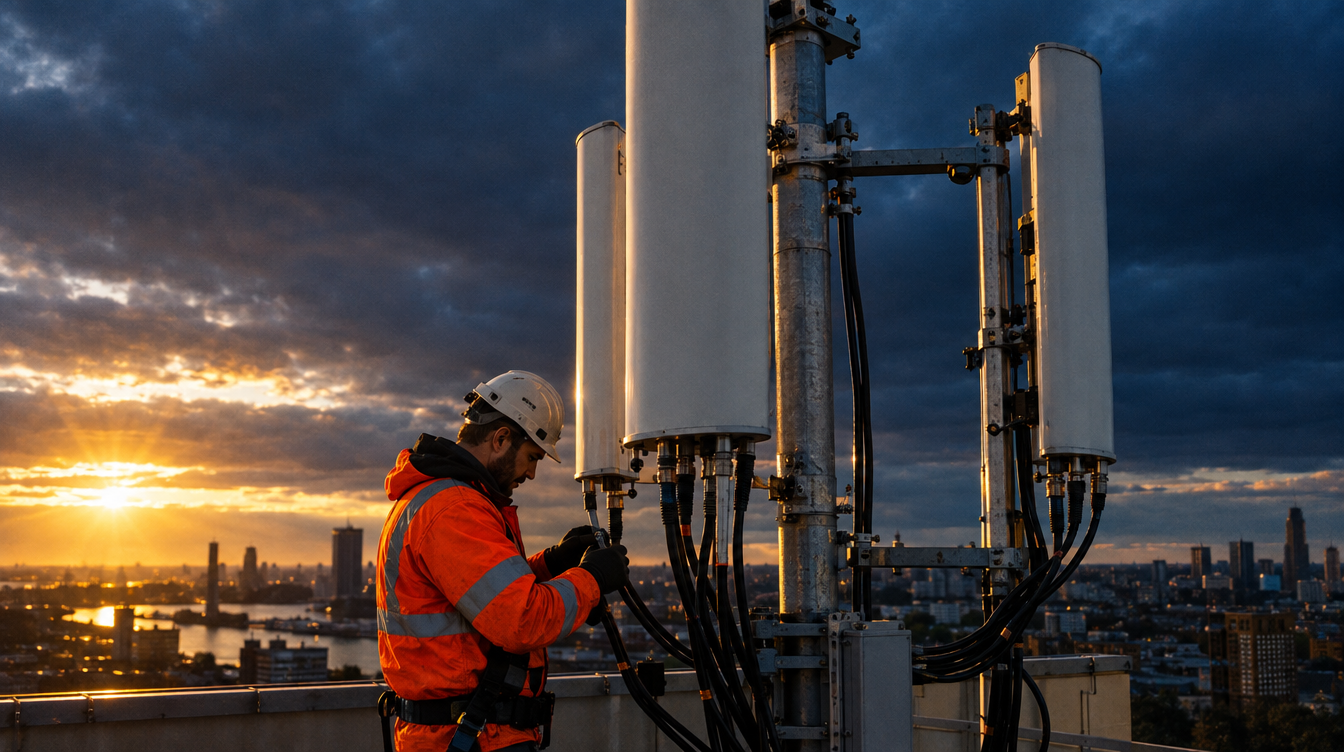
With Airwave continuing to carry UK emergency services voice traffic while ESN is developed, TETRA infrastructure has to stay reliable for longer than many sites were originally planned for. Base station antennas, feeders and connectors are the parts most exposed to weather, and they are where slow degradation tends to start.
Why antenna faults go unnoticed
An antenna rarely fails outright. Water gets into a connector, a radome cracks, a clamp loosens and the mast flexes. Each of these raises VSWR or adds loss a little at a time. Coverage shrinks at the edges first, and the first sign is often a user report of poor audio in a location that used to be fine.
A sensible maintenance routine
Most operators work to an annual inspection, with extra visits after severe weather. A routine visit should cover:
- Visual inspection. Check radomes for cracks, chalking or discolouration. Check that the antenna is vertical and the mounting clamps are tight.
- Connectors and weatherproofing. Look for split self-amalgamating tape, perished boots and green corrosion on N-type connectors.
- Feeder condition. Check for crushed sections, tight bends below the minimum bend radius and loose cable cleats.
- Earthing and surge protection. Confirm bonding straps are intact and arrestors are in place.
- RF measurements. Measure return loss or VSWR at the transmitter end and compare it against the commissioning baseline.
Use distance to fault
A single VSWR figure tells you something is wrong but not where. A distance-to-fault sweep shows reflections along the feeder, so you can see whether the problem is at the antenna, a joint, or a damaged section of cable. Keep the commissioning sweep on file for every site, as a comparison is far more useful than a single reading. Our VSWR and return loss guide explains how to read the results.
Combiners and filters
Multi-channel TETRA sites usually feed several transmitters into one antenna through combiners and duplex filters. Check that cavity tuning has not drifted, and that connectors between units are tight. A fault in a combiner can look like an antenna fault from the transmitter end. See our guide to duplexers, combiners and couplers.
When to replace rather than repair
Replace an antenna when the radome is cracked, when return loss has drifted well beyond the baseline with good connectors, or when the antenna has been in service far beyond its expected life on an exposed site. Replacement antennas for the 380 to 400 MHz TETRA band include the UHF43 A/B/C/D/E, the BASE304 3 dBd series and the UHF46 A/B/C/D. For wall-mounted sites, the WM-70-1G covers 380 to 470 MHz.
Frequently asked questions
How often should TETRA base station antennas be inspected?
Most operators inspect annually, with extra visits after severe weather or reported coverage problems. Exposed coastal and hilltop sites may justify more frequent checks.
What return loss is acceptable on a base station feeder?
Compare against the commissioning baseline for that site rather than a single fixed figure. A noticeable drift from the baseline is the signal to investigate.
Can I replace an antenna with a different model?
Yes, if it covers the same frequency range and has a similar radiation pattern and gain. A change in gain or beamwidth will change coverage, so review the site plan first.
For a wider view of the network these sites support, read our ESN progress update. For replacement antennas or advice on a site, contact sales@renair.co.uk.
Understanding the Innovative Technologies Behind Our Antenna Solutions
At Renair, we utilise cutting-edge technology to design antennas that excel in performance and reliability. Our manufacturing process incorporates rigorous testing to ensure each product meets the highest standards. This commitment to quality guarantees that our antennas provide seamless connectivity for a variety of applications.

LoRaWAN Gateway Antennas: Siting and Selection
Choosing and siting LoRaWAN gateway antennas in the UK 868 MHz band: gain, height, ERP limits, cable loss and mounting for reliable IoT coverage.

Antenna Separation on Multi-Antenna Vehicle Roofs
How to lay out TETRA, cellular, GNSS and Wi-Fi antennas on one vehicle roof to avoid interference, desensing and lost GNSS lock.

Marine VHF Antenna Selection for Workboats
How to choose a marine VHF antenna for workboats, pilot vessels and patrol craft: gain versus roll, length, mounting and cable loss explained.
Our Customers
Lorem ipsum dolor sit amet, consectetur adipiscing elit.
“The team at Renair is always ready to assist, providing expert advice and quality products.”


“Renair’s bespoke antenna solutions have significantly enhanced our system performance.”

“We rely on Renair for all our antenna needs. Their products and service are consistently excellent.”

“Renair’s team provided exceptional support throughout our project, ensuring seamless integration.”

“The quality of Renair’s antennas is unmatched. Our communications have never been clearer.”

“Renair’s customer service is top-notch. They promptly addressed our queries and provided tailored solutions.”


Get in Touch with Us
Contact Renair today for inquiries, partnerships, or to learn more about our solutions.