Sector Antennas for DAS and In-Building Coverage

Why DAS is having a moment
Distributed Antenna Systems (DAS) are no longer reserved for stadiums and airports. Hospital trusts, logistics centres, transport hubs and large commercial buildings are all specifying in-building coverage as a non-negotiable for public safety, operator cellular and private radio. As the ESN migration accelerates, expect the DAS market to grow further.
Sector vs omnidirectional
The default instinct of many designers is to reach for omnidirectional antennas inside a building. For open atria, stairwells and wide loading bays, that can be the right call. However, the moment a building has structured corridors, linear floorplates, or coverage requirements that reach only in certain directions, a sector antenna is usually the smarter specification.
- Sector antennas concentrate radiated power in a defined beamwidth.
- That means higher effective gain in the direction you actually care about.
- It also means less power wasted into areas that do not need coverage, reducing interference and simplifying RF planning.
Typical beamwidth choices
For in-building DAS, the usual sector beamwidth options are 60, 90, 120 and 180 degrees.
60 degrees
Long corridors and linear floorplates. Maximum range for minimum spill into adjacent spaces. Common in hospital corridors and rail platform tunnels.
90 degrees
Classic choice for sectorised corners and three-sector rooftop repeaters. A good general-purpose beamwidth for structured indoor environments.
120 degrees
The most common outdoor sector, also useful for large open-plan floors where coverage needs to fan out across a wide arc from a single mount point.
180 degrees
Wall-backed spaces where you only need to radiate into one half of the room. Useful for loading bays, external canopies and spaces bounded on one side by a solid wall.
Design questions worth asking early
- Which bands does the DAS need to support today, and which are likely to be added in three years?
- Are you designing for operator cellular only, or do public safety bands (TETRA, LTE public safety) also need covering?
- What are the acceptable signal levels at the cell edge, and how are you measuring them?
- Are there PIM performance requirements? In-building DAS often drives tighter PIM specs than outdoor.
- Which surfaces will the antennas be mounted to, and is the building's cabling infrastructure already in place?
Where Renair fits
We supply a range of sector antennas suitable for in-building DAS deployments across UHF, public safety and cellular bands. For more specific projects, including narrowband and unusual mounting requirements, our engineering team can scope a bespoke solution. Send the design brief to sales@renair.co.uk and we will come back with a candidate specification and lead time.
Understanding the Innovative Technologies Behind Our Antenna Solutions
At Renair, we utilise cutting-edge technology to design antennas that excel in performance and reliability. Our manufacturing process incorporates rigorous testing to ensure each product meets the highest standards. This commitment to quality guarantees that our antennas provide seamless connectivity for a variety of applications.
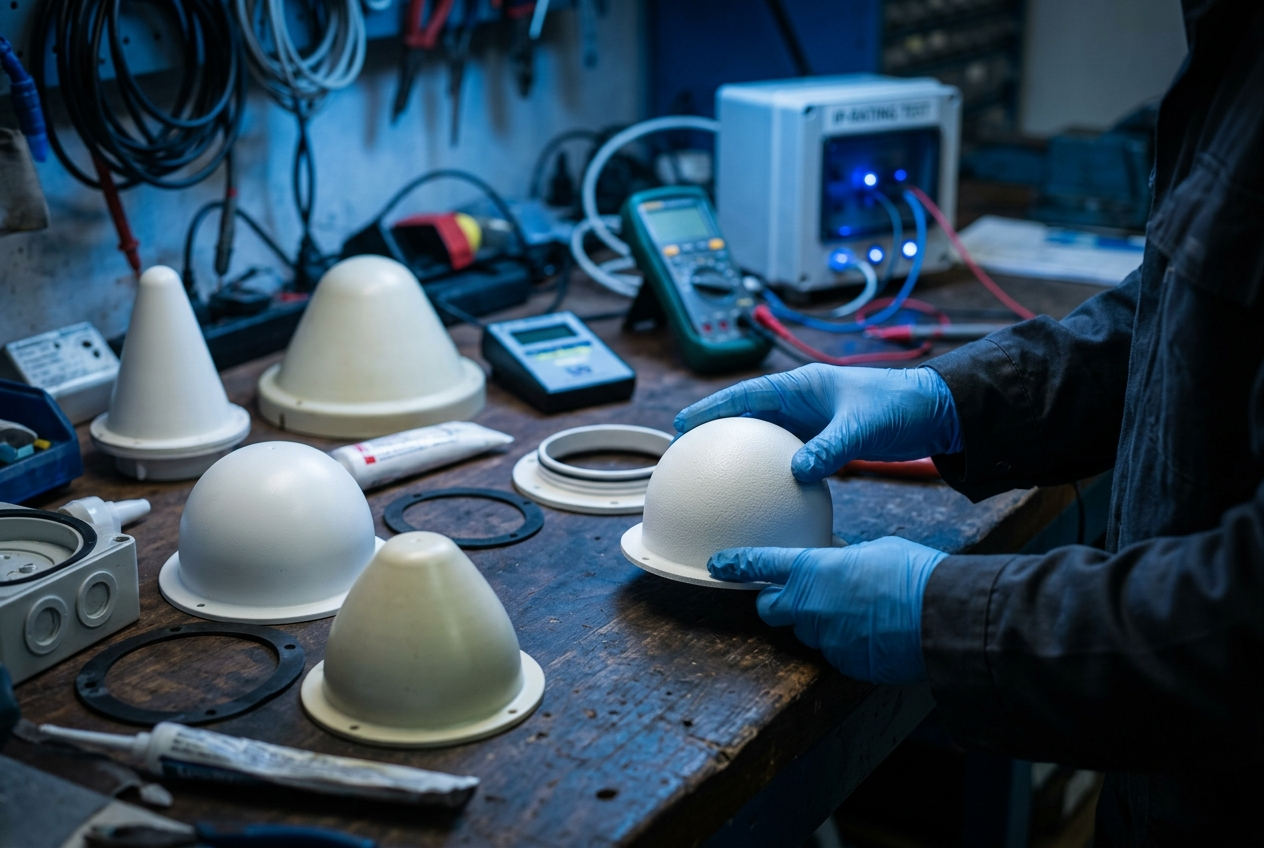
Choosing Antenna Housings and Radomes: Materials, IP Ratings and UV Resistance
A practical guide to radome materials, IP ratings, and UV resistance for specifying durable antenna housings on UK installations.

Antenna Diversity and MIMO for Fixed Wireless Access: What UK ISPs Need to Know
How antenna diversity and MIMO improve fixed wireless access performance, and what UK ISPs should specify for reliable, high-throughput deployments.

Preparing Antenna Installations for Autumn and Winter: A UK Storm-Season Checklist
A practical pre-winter checklist for UK antenna installations covering wind loading, weatherproofing, grounding, and post-storm inspection routines.
Our Customers
Lorem ipsum dolor sit amet, consectetur adipiscing elit.
“The team at Renair is always ready to assist, providing expert advice and quality products.”


“Renair’s bespoke antenna solutions have significantly enhanced our system performance.”

“We rely on Renair for all our antenna needs. Their products and service are consistently excellent.”

“Renair’s team provided exceptional support throughout our project, ensuring seamless integration.”

“The quality of Renair’s antennas is unmatched. Our communications have never been clearer.”

“Renair’s customer service is top-notch. They promptly addressed our queries and provided tailored solutions.”


Get in Touch with Us
Contact Renair today for inquiries, partnerships, or to learn more about our solutions.